
Yokai Supplement: Oitekebori (a type of yokai) | Social Issues: Share Happiness Detox

A small bottle to leave by your door on Tuesdays - that's "Yokai Supplement." This is a series that will raise your sensitivity to yokai by digging into their stories a little at a time. We'll introduce them in a relaxed manner, adding our own unique perspective as a yokai specialist.
[Name of the yokai] Oitekebori
Yokai Nutrients: Social Issues: Share Happiness Detox
What kind of monster?
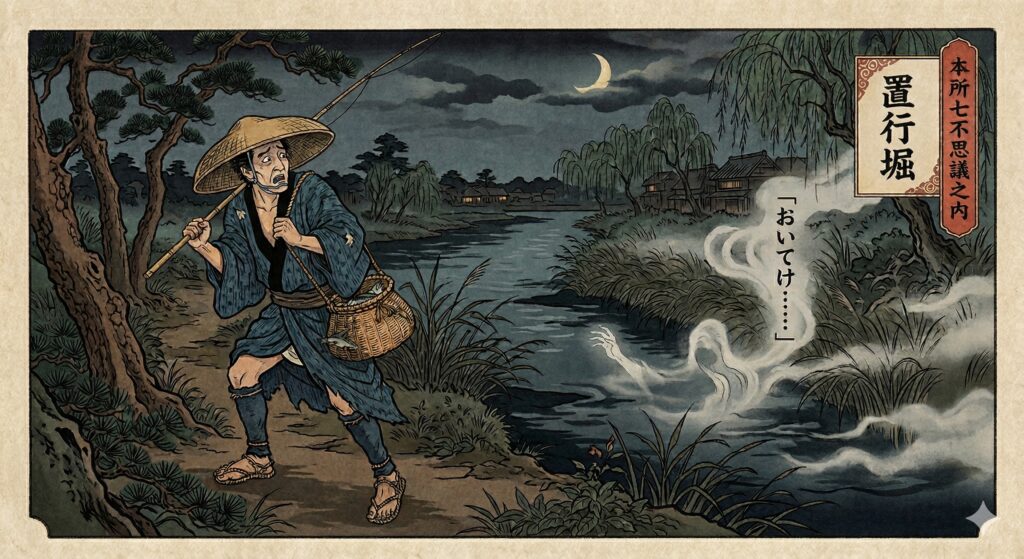
This refers to the phenomenon, or the person responsible for it, of hearing an eerie voice from nowhere saying **"Leave it behind..."** on one's way back from fishing in the moat of Honjo, Edo (present-day Sumida Ward, Tokyo).
Though unseen, the sound frightens those who flee, only to find their fish basket empty. Attempting to take the fish home by force will result in a terrible fate. This episode is considered the foremost in the Edo-period collection of ghost stories, "The Seven Mysteries of Honjo." There are various theories about its true identity, with some whispering it's the work of a kappa (water imp) that has lived in the area since ancient times, or a badger craving fish.
efficacy
It gives you the courage to "cut your losses." It's effective in helping you organize your thoughts so that you can let go of achievements that are beyond your control or attachments that are inappropriate for you at the right time.
Where will it appear?
The story is set in a moat that is said to have been located near Kotobashi in present-day Sumida Ward, Tokyo. It was once a place of intricate waterways, where darkness reigned at night due to the lack of streetlights. In modern times,The moment when lingering regret surfaces, thinking, "We've come this far, after all this effort."—For example, they might appear in offices late at night, or on the way home from a project where you've lost track of when to quit.
Considerations from a Yokai Shop
Here, as a yokai lover, I read it like this.
"Okigyo-bori" (a type of ditch or moat) is not simply a matter of plunder, but rather **a warning from nature (or society) against excessive prey**.
In Edo, waterways were vital for logistics and a source of abundance. However, those who tried to monopolize excessive profits from them were caught off guard. That voice saying, "Leave it behind," might just be an auditory hallucination, a sound echoing from our own inner greed.
A casual reflection by a yokai shop owner (What lies behind the concept of "wastefulness")
In modern Japanese, the expression "to leave someone behind" is expressed as "to leave someone behind," and its origin lies in this yokai (supernatural creature). What's interesting is that it's not the yokai that leaves humans behind, but rather **"humans leaving their prey behind"** that is the original form of the expression.
We are extremely afraid of losing something, but sometimes the best survival strategy is to "leave your prey and run away with nothing but yourself." When you hear the voice of the "Leave it behind" lurking, it's a question asking, "Do you really need that right now?" It's a perfect opportunity (detox) to put down the burdens you've been carrying too much.
3-line summary (today's amount)
- Oitekebori is one of the seven mysteries of Honjo, where people call out to fishermen to "leave" the fish they have caught.
- It is said to be a supernatural phenomenon brought about by attachment and greed, and that misfortune will befall anyone who tries to take it home by force.
- Today's Yokai Nutrients Social Issues: Share Happiness DetoxThe courage to deliberately leave behind those obsessive attachments you've been holding onto.
Next Yokai Supplement Preview
Next week, we'll prescribe a treatment for that monster that doesn't stop you on the street, but rather **"makes you trip and fall on the street for no reason."** Along with the sharp pain, we'll bring you the wisdom to laugh off your bad luck.




No comments yet.